Picking an ELT connector feels like choosing a plumbing system for your house. If it’s quiet and boring, you win. If it leaks at 2 a.m., you lose a weekend.
The quick takeaway for Fivetran Airbyte Stitch in 2026 is simple: Fivetran is the most hands-off, Airbyte is the most flexible, and Stitch is the lightest starting point, but often needs more babysitting as you grow. The right choice depends on how much ops you can handle, how messy your sources are, and how sensitive you are to volume-based costs.
How ELT pipelines work in 2026 (and where these tools sit)
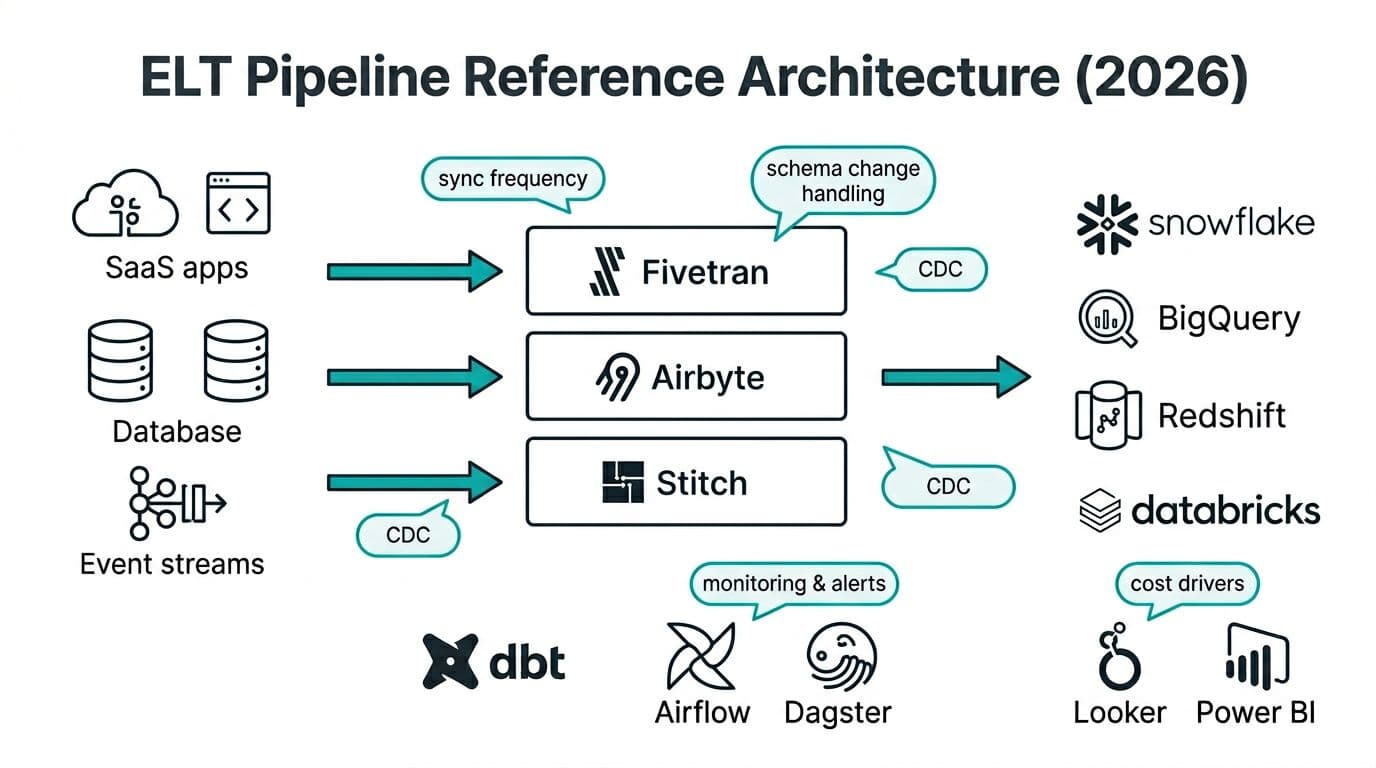
In most small teams, ELT means: pull from apps and databases, load into a warehouse, then transform with dbt. You want the connector layer to do three jobs well: sync on schedule, handle schema changes, and alert you before dashboards break.
Here’s how the three tools tend to behave in real life:
- Fivetran is built for “set it up once” reliability. It’s usually the best fit when you can’t afford pipeline babysitting and you want strong defaults for schema drift, monitoring, and governance.
- Airbyte shines when you need control. You can self-host, customize connectors, and ship fixes faster when your setup is unusual. The tradeoff is that you own more of the reliability story.
- Stitch is straightforward when you’re starting with common sources and batch reporting. However, once you have many connectors or fast-changing APIs, you may spend more time chasing edge cases.
If you want a broader view of the market (including tools built for streaming), this best ETL and ELT tools list for 2026 is useful context, especially when your needs go beyond “sync SaaS data daily.”
Pricing and ops tradeoffs: what drives your bill (and your stress)
All three products usually scale cost with data volume, but they measure “volume” differently. So two teams with the same warehouse bill can pay very different connector bills.
Typical cost drivers in 2026 look like this:
- Sync frequency: Hourly marketing and product data multiplies row churn. Daily finance data stays calmer.
- Row churn and updates: CDC and upserts can re-touch lots of records, even when your business changes little.
- Schema drift: New fields, nested JSON, and API version changes increase maintenance, even if the connector “supports” the source.
- Connector quality and ownership: Fully managed connectors reduce your ops work, but you pay for that reduced work.
Fivetran commonly uses a model based on monthly active rows (how many unique rows are moved in a month). Airbyte Cloud tends to use credits, while Airbyte open-source shifts cost to your infrastructure and the time you spend running it. Stitch often prices around rows replicated with plan limits and add-ons.
If you’re cost-sensitive, test with your real volume early. A pipeline that’s cheap at 1 sync per day can get expensive fast at 24 syncs per day.
For marketers pulling lots of ad data, it helps to see how vendors frame the “marketing-heavy” use case. This 2026 Stitch alternatives breakdown highlights why high-churn sources (ads, keywords, campaign stats) can punish volume-based pricing.
A decision matrix to choose Fivetran, Airbyte, or Stitch (fast, but not sloppy)
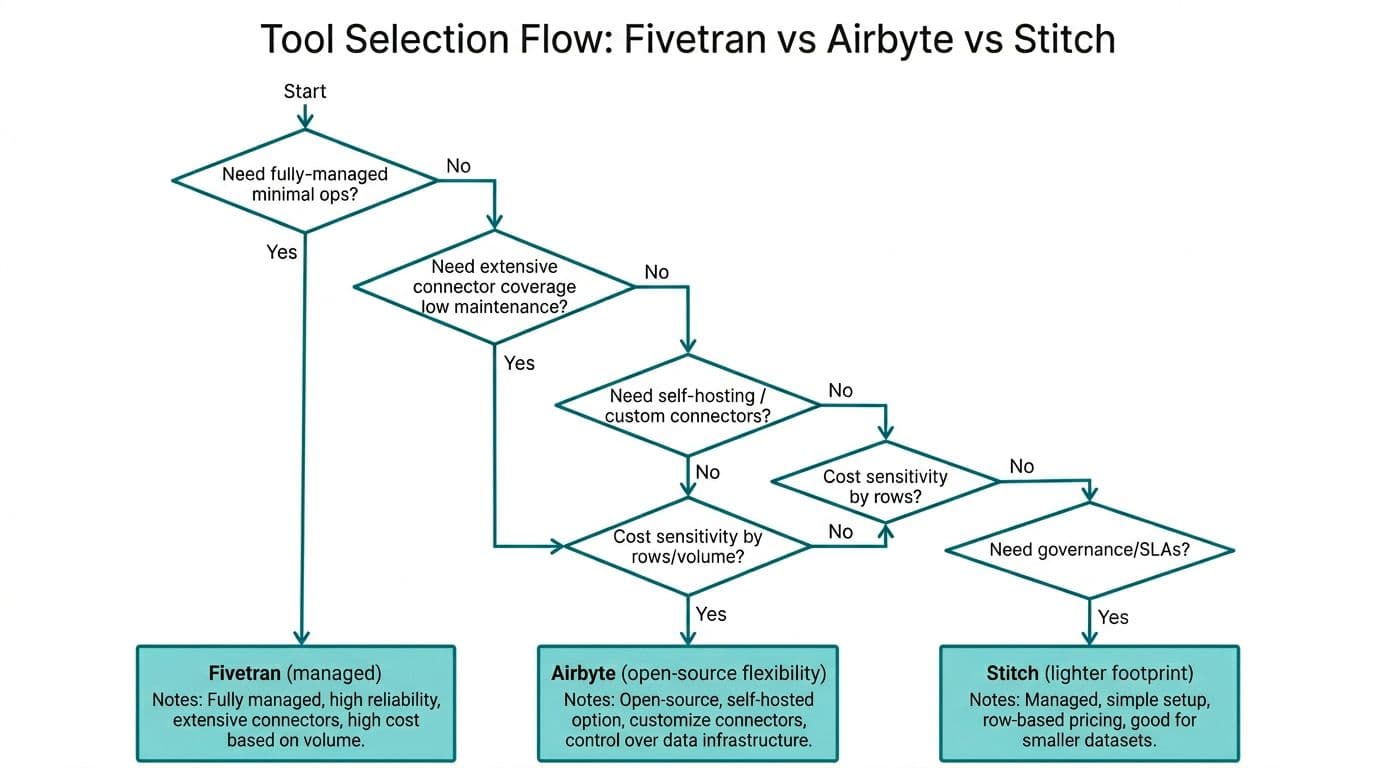
Score each criterion from 1 to 5 (1 is weak, 5 is strong) for your situation. Then multiply by weight. Don’t aim for perfect math, aim for clarity.
| Criteria (score 1 to 5) | What “5” means | Suggested weight |
|---|---|---|
| Managed reliability | Minimal maintenance, strong uptime, clear alerts | 3 |
| Connector coverage | Your sources are supported well, not just “supported” | 3 |
| Custom connector needs | Easy to build, run, and maintain custom sources | 2 |
| Cost control at your volume | Predictable spend, good controls and warnings | 3 |
| Schema change handling | Works without manual fixes when fields change | 2 |
| Security and governance | RBAC, auditability, safe handling of credentials | 2 |
| Self-host option | You can run it on your infra when needed | 1 |
How to score quickly: pick 3 real sources (for example Stripe, HubSpot, Postgres), one messy source (ads or webhooks), and your destination. If the tool can’t do your messy source well, cap “connector coverage” at 2 or 3.
A common outcome looks like this: Fivetran scores highest on managed reliability and governance, Airbyte scores highest on self-host and custom connectors, and Stitch stays competitive when you keep scope small and batch-based.
Pilot, adoption, and integration plan (dbt + orchestration included)
A pilot is where most teams either build confidence or uncover hidden costs. Keep it short, and make failure obvious.
Run a 7-day pilot with success metrics and failure tests
Use 3 to 5 sources that match your real workload:
- Marketing SaaS: Google Ads or Meta Ads (high churn, lots of small updates)
- Sales SaaS: HubSpot or Salesforce (schema drift happens)
- Payments: Stripe (events and refunds test updates)
- Database: Postgres or MySQL (CDC and incremental loads)
- Product events (optional): only if you must, because ELT connectors are not streaming tools
Pilot success metrics should be measurable:
- Freshness: 95 percent of tables land within your target lag (for example, under 60 minutes).
- Completeness: row counts match within an agreed tolerance (for example, plus or minus 1 percent).
- Stability: zero silent failures, every failure triggers an alert and a clear log trail.
- Cost predictability: you can explain what changed when spend changes.
Then add failure tests on purpose: rotate an API key, add a new field to a JSON payload, and backfill a large date range. If the tool can’t recover cleanly, that’s not a “later” problem, it’s a now problem.
30–60–90 day adoption plan for small teams
This plan assumes you’re building a durable pipeline, not a one-off export.
| Timeline | What you ship | What you measure |
|---|---|---|
| 30 days | 3 to 5 core connectors, alerting, basic access control | freshness, failures per week, time to recover |
| 60 days | dbt models for core reporting, documented schemas, tests | data quality test pass rate, model run time |
| 90 days | expand connectors, cost guardrails, incident playbook | cost per source, mean time to detect and fix |
Integrating with dbt and an orchestrator (without getting locked in)
Most teams do best with a simple contract: ELT loads raw tables, dbt transforms them, and the orchestrator coordinates the timing.
A practical pattern:
- After each sync, trigger your dbt job (or run dbt via your orchestrator).
- In dbt, separate staging models (light cleanup) from marts (business logic).
- Add tests early: uniqueness, not null, and freshness checks catch connector issues fast.
- Orchestrate retries carefully. Retries should not create duplicate loads or partial transforms.
This is where managed reliability matters. If your connector fails often, your orchestration turns into a patchwork of exceptions.
When not to use an ELT connector
ELT connectors aren’t the right hammer for every nail.
Skip them when you have:
- High-volume event streaming (clickstream, in-app events) that needs second-level latency
- Complex transformations pre-load (PII redaction, heavy joins) that must happen before storage
- Strict, custom SLA logic where you need full control over retries, ordering, and exactly-once handling
In those cases, you’ll likely want a streaming or CDC-first setup. If Stitch is your baseline today and you’re outgrowing batch, this Stitch competitor roundup is a helpful map of options that focus on real-time movement.
Internal-linking plan (companion articles to publish next)
To help readers move from choice to execution, link this article to:
- ELT pipeline checklist for startups (setup steps, owners, and runbooks)
- CDC in ELT: when it helps and when it hurts (row churn, cost, and correctness)
- dbt orchestration patterns (per-sync runs, daily batches, and backfills)
- Data pipeline observability for small teams (alerts, SLIs, and incident routines)
Conclusion
Fivetran, Airbyte, and Stitch can all move data, but they don’t cost the same in time and attention. If you want the quietest setup, Fivetran often wins. If you need control and customization, Airbyte stands out. If you’re keeping it simple and batch-based, Stitch can still be enough, until it isn’t. Pick the tool that matches your ops budget, not just your feature list.
