Most teams comparing clay vs clearbit vs apollo are not choosing between three versions of the same tool. They are choosing between three operating models. Clay is an orchestration layer. Clearbit, now tied to HubSpot’s Breeze Intelligence, is a native enrichment option for HubSpot-centric teams. Apollo is a prospecting database with outreach built in.
That matters because enrichment is rarely one job. You may need list building, CRM field fill, account research, waterfall email finding, or signal-based routing. The right fit depends on where data starts, where it ends, and who owns cleanup.
Start with the role each platform plays
The first decision point is simple: do you need a data system, a HubSpot enrichment layer, or an all-in-one sales tool?
Clay works best when you want to combine sources, apply logic, and push clean records into other systems. It fits teams building repeatable workflows, not teams looking for a single database.
Clearbit is harder to judge in 2026 under the old name alone. HubSpot bought Clearbit in 2023, and many teams now see it as Breeze Intelligence. Packaging and limits can change, so verify current HubSpot product details before buying. In practice, it is strongest when HubSpot is the center of your form, CRM, and scoring setup.
Apollo gives you prospect search, basic enrichment, and outbound execution in one place. That makes it fast to launch. The tradeoff is less control over master data.
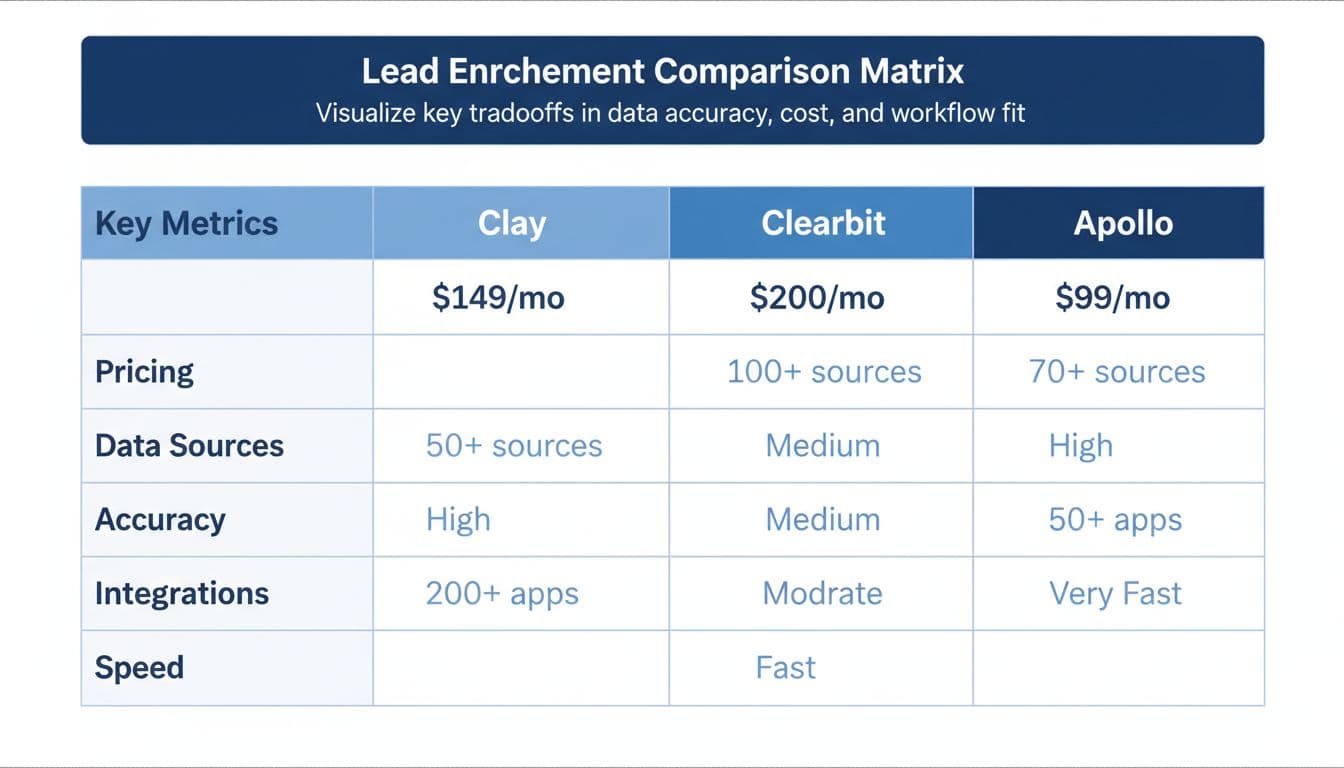
This quick matrix keeps the roles clear:
| Decision point | Clay | Clearbit / Breeze Intelligence | Apollo |
|---|---|---|---|
| Core role | Orchestrates many data sources | HubSpot-native enrichment | Prospect database plus outbound |
| Best fit | Waterfalls, custom logic, automation | Forms, CRM, scoring in HubSpot | List building, rep workflow, sequencing |
| Main limit | More setup, no native sequencing | Most useful inside HubSpot | Less control over data quality rules |
| When it matters | Multi-tool stacks | HubSpot-first teams | Small teams moving fast |
Seen another way, Clay is the builder’s tool, Breeze is the HubSpot-native tool, and Apollo is the rep-speed tool.
Where each tool wins in real enrichment workflows
Tool choice gets easier once you map it to a live workflow.
Prospect list building and outbound support
For net-new list building, Apollo usually wins. You can search contacts, export or sequence them, and get reps moving fast. That is why many teams start there. If you want a second view on sourcing versus enrichment, this Clay vs Apollo breakdown shows that split well.
Clay can support prospecting, but mostly by enriching lists sourced elsewhere or by combining providers to improve coverage. Breeze Intelligence is not the strongest fit for outbound-first list building because its value sits in CRM and website enrichment.
This difference matters most when one person owns both sourcing and first touch. Apollo cuts tool switching. Clay does not.
CRM enrichment and form capture
When CRM health is the decision point, the center shifts. Breeze Intelligence is often the cleanest choice for HubSpot users who want company data, shorter forms, routing, and lead scoring inside one stack. For HubSpot-heavy teams, this HubSpot enrichment tool review is a useful cross-check.
Clay is stronger when enrichment spans more than one system. If records move between HubSpot, Salesforce, Sheets, a warehouse, and outbound tools, Clay gives you more control over field mapping and fallback logic. Apollo can append data, but it is usually not the first choice for long-term CRM hygiene.
Waterfall enrichment, account research, and signal-based automation
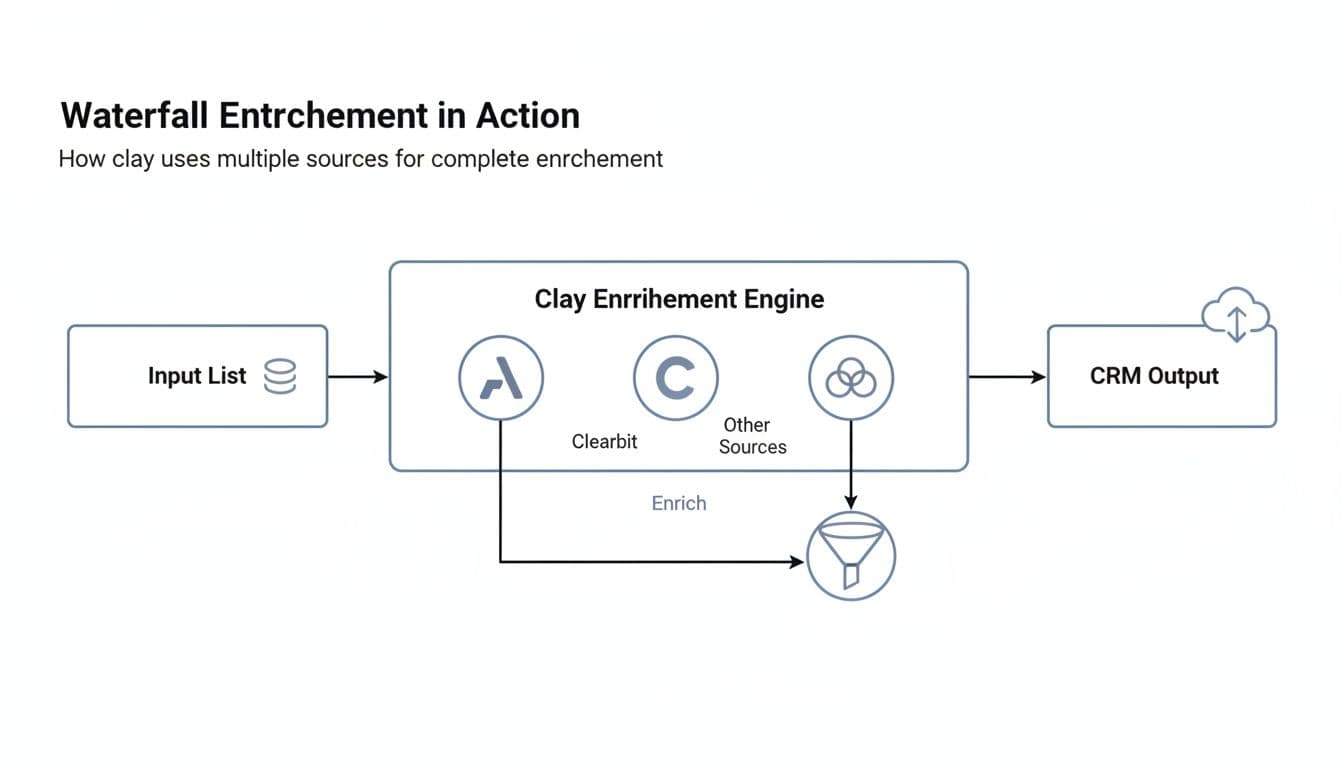
Clay stands out here because it can query multiple providers in sequence, apply formulas, and only move records when rules match. That helps with waterfall email finding, account research, and trigger-based workflows.
Apollo still has a role. Many teams use it as a source inside a wider process, especially when speed matters more than orchestration. Breeze Intelligence can also matter here if your signals live inside HubSpot and you mainly care about routing or scoring, not multi-source logic. For a wider category view, this 2026 B2B enrichment overview helps frame the tradeoffs.
The best enrichment tool is the one that fills the right fields, in the right system, with the least cleanup.
Best choice by team and operating model
Best choice for RevOps teams
If RevOps owns schema and sync quality, governance matters most. Clay is often the better fit for multi-tool stacks and custom rules. Breeze Intelligence is often better when HubSpot is the operating system and the goal is native enrichment with less maintenance. Apollo fits lean teams, but it is harder to treat as the source of truth.
Best choice for outbound teams
Apollo is usually the practical pick for teams that need one login for search, enrichment, and sequencing. Reps can build a list and launch touches the same day. The limitation is consistency. If routing, reporting, and compliance depend on stable fields, that tradeoff matters more.
Best choice for custom enrichment workflows
Clay is the clearest choice when you want custom waterfalls, trigger-based enrichment, account scoring, or mixed data providers. It asks for more operator time. Still, that work pays off when enrichment sits inside a larger automation system.
Run a 100-record pilot before you buy
Don’t pick from feature pages alone. Run the same 100 records through each tool, or through the combo you may actually use, such as Apollo plus Clay.
- Pick records that reflect real work, new prospects, old CRM contacts, and form fills.
- Set success fields first, such as work email, title, employee count, industry, owner routing, and sync success.
- Score each tool on coverage, freshness, time-to-value, and manual cleanup.
- Track downstream results, bounce rate, routing errors, and whether automations fired correctly.
This pilot can feed a lead enrichment workflow checklist, a CRM enrichment playbook, and a data provider comparison.
The practical verdict
If you want speed and built-in outbound, Apollo usually makes the shortlist. If you want HubSpot-native CRM enrichment, Clearbit’s current Breeze Intelligence path deserves a close look. If you want control, Clay is hard to beat. Test with live records, then buy for workflow fit, not feature volume.
